Resources for you and your office

CTEXLI at a Glance
Get a comprehensive look at CTEXLI—from how it works to how it’s taken and more.
Painting Family Video
Hear from the Painting family as they discuss their experience with CTX and their treatment journey with CTEXLI.
[00:00:00]
[music]
[background conversation]
Thea: One word that comes to mind that I can think to describe my family would be vivacious and loud.
Brendyn: We are like [00:00:30] this constantly. We love being around each other. We're always joking, always having fun. Growing up and being a Painting was pretty eventful in a lot of good ways.
Monica: Thea is definitely—I used to call her my brain, and she'll tell you that.
Rodney: She's the oldest.
Monica: She's the oldest. Bren was always my helper. She still is.
Rodney: Brendyn is very practical, good at solving everyday problems.
Monica: Then Kobi was a baby that [00:01:00] we were always chasing after and—
Rodney: Chaos master.
Monica: Yes, chaos master. [laughs]
Kobi: Growing up, we always knew something was wrong with my sisters, and there was never anything wrong with me. They were always in the doctor with so many different symptoms.
Monica: Thea had jaundice. She was born with jaundice, and so right off the bat, I knew something was up. I had other friends who were my same age that were having children at the same time. Their babies, their diaper changes were only [00:01:30] every five hours, six hours, something like that. My kids were constant.
Rodney: I would say within six months we started to notice that, "Okay, our child is—there's some things going on that's different than other children."
Monica: Than our friends.
Thea: I had to have a bathroom within reach of wherever I was. Especially when I was in school, it would be up to seven, eight, nine times a day. I feel like that hindered my schooling a [00:02:00] little, like missing important things in class, because I was having to get up and leave the room so many times.
Rodney: Then Brendyn started experiencing the same symptoms, and they were chronically in the restroom.
Brendyn: My teacher would literally have to come in the restroom and be like, "Hey, are you okay?" I was wasting away. I look like a zombie. It was a nightmare. I was like [00:02:30] extreme brain fog, you just felt like you're in a cloud and everything is just smoky, you can't think.
Monica: They were both there. They were both in the fog. We just didn't know why.
Thea: I struggled really, really bad with my balance. I cannot count how many times, when I was between the ages of probably seven to nine, how many times I fell and tore my hands up or my knees.
Brendyn: I was 15 years old [00:03:00] when they found the first cataract on my eye. It almost looked like looking through Vaseline or something. I couldn't see when I danced, I couldn't keep my balance. It just impeded my everyday life, everyday. It was rough, sorry. I got those removed, and then the same thing happened for her. It was like two sisters just don't randomly get cataracts.
Rodney: Yes, I know they're sisters, I know they're related. [00:03:30] We all share some of the same anomalies, but this is pretty crazy.
Monica: We knew that something was abnormal about it, but they just kept telling us there was nothing wrong. There was absolutely nothing wrong.
Rodney: Multiple—
Monica: That was just odd.
Rodney: 10 to 15 doctors told us the same thing.
Thea: My Aunt Ashley is more like a big sister. The bond that we had with her growing up was very strong. My Aunt Ashley [00:04:00] is a physician, she's a pediatrician. When we were going through all of this, she was doing her research. Especially after I was diagnosed with cataracts, she was like, "Hmm, this sounds like genetic."
Dr Sarah Ashley: Cataracts are such an unusual diagnosis in pediatrics that it really warrants further investigation for the cause. When my nieces went to the doctor for their chronic diarrhea, they received an explanation that there was just more [00:04:30] water in their colon and that was contributing to their diarrhea. I never accepted that as an explanation for what was going on. I always felt like there was something more to the story. All of my struggles to get to medicine, all of that drive to understand disease, had been there to help my sister find an answer for her children.
Monica: After the cataract diagnosis, I called Ashley, and I said, "Thea [00:05:00] has developed cataracts now," and she went, "Oh my god, this is genetic." She said, "I know it."
Dr Sarah Ashley: I think I was a second-year medical student at that point. We sat on the phone, and I pulled up the Online Mendelian Index database, and I plugged in every symptom that they had. We did a search, and we found several different genetic disorders, and we read through each of them together. When we read through the CTX entry in the database, my sister cried, [00:05:30] and she said, "Oh my God, this is it. This is everything they have."
CTX is a disorder of cholesterol metabolism in which cholesterol can get deposited into other organ systems in the body, including the brain, and the heart, the tendons. It can cause cataracts. It is a frequent cause of chronic diarrhea in infants. It can result in learning disabilities and cardiovascular disease, and it can limit the life expectancy of patients.
Monica: [00:06:00] I cried and cried and cried because I said, "This is my kid." At the time, I didn't even realize that Brendyn had the exact same thing because I didn't know. I was like, "This is Thea's life. This is what she's experienced." I said, "Is there a treatment?" She said, "Yes." My sister gave us the diagnosis, [00:06:30] went to the geneticist, and he was like, "Your sister's exactly right." He said, "This is CTX." After they started taking CTEXLI, Thea and Bren, we noticed the fog cleared. They were able to do things that they had not done before. The going to the restroom, like that, went away.
Kobi: Being on treatment was definitely a big deal because they went [00:07:00] from truly suffering for such a long time to being able to experience life.
Thea: It was just I felt good. I felt happy. I didn't feel sick because I had always felt sick and tired, and I would wake up and I was like, "God, another day of this." I didn't have to wake up like that anymore. I don't know, I felt normal.
Monica: The big thing for me, because I'm an educator, [00:07:30] was that the fog had cleared.
Brendyn: CTEXLI has really brought that normality back to me. My whole world is open to so many different possibilities now. After beginning CTEXLI, I was a little nauseated on and off throughout the day, and then I had some acid reflux issues until it eventually faded away after a few weeks.
Thea: After starting CTEXLI, [00:08:00] I experienced about a week of nausea, but then after that, it went away, never came back. Since then, I've not had any issues.
Rodney: There's always this frustration every time she and I still look at each other. It's like, "What if somebody would have just tapped into this 5 years before, 10 years before?"
Monica: What would have happened had they been diagnosed?
Rodney: Way earlier.
Dr Sarah Ashley: I want this message to reach other families like mine, [00:08:30] to reach a mom who is looking for answers, to reach another young adult who's affected by CTX, who's trying to navigate that diagnosis and what life is like. I want people to know that this disease exists and to know that there's a treatment.
Brendyn: I always felt so alone, and I'm so glad that I could share my story. [00:09:00] Because I never thought I would be able to like this, and I'm so glad I could. It's a blessing.
Thea: Even when there are no answers, and you feel like you're shouting into the darkness. You think no one in the world hears you. On the other side of that is a life full of possibilities.
[pause 00:09:28]
[00:09:30]
[music]
Speaker:
INDICATION
CTEXLI is indicated for the treatment of cerebrotendinous xanthomatosis, CTX, in adults. [00:10:00]
IMPORTANT SAFETY INFORMATION
WARNINGS AND PRECAUTIONS
Hepatotoxicity: Chenodiol, including CTEXLI, has been associated with hepatotoxicity. Patients with preexisting liver disease or bile duct abnormalities may be at a higher risk for hepatotoxicity during treatment.
Before initiating CTEXLI, obtain baseline liver transaminase (alanine aminotransferase [ALT] and aspartate aminotransferase [AST]) and total bilirubin levels in all patients. Monitor [00:10:30] liver transaminase (ALT, AST) and total bilirubin levels yearly and as clinically indicated. If liver transaminase levels are elevated >3 times the upper limit of normal (ULN) or total bilirubin level is >2 times ULN, interrupt treatment until the levels have returned to baseline values. For persistent or recurrent liver test abnormalities, consider discontinuing CTEXLI.
Inform the patient of the symptoms of hepatotoxicity (e.g., abdominal pain, bruising, dark-colored urine, [00:11:00] fatigue, bleeding, jaundice, nausea, and pruritus). Have the patient discontinue CTEXLI immediately if clinical signs and symptoms consistent with hepatotoxicity occur.
ADVERSE REACTIONS
The most common adverse reactions (≥14%) during CTEXLI treatment were diarrhea, headache, abdominal pain, constipation, hypertension, muscular weakness, and upper respiratory tract infection.
DRUG INTERACTIONS
Bile acid sequestering agents and aluminum-based antacids: [00:11:30] Avoid concomitant use with CTEXLI. Co-administration of bile acid sequestering agents, such as cholestyramine and colestipol, or aluminum-based antacids may decrease absorption of CTEXLI in the intestine and may result in decreased efficacy.
Coumarin and its derivatives: Monitor prothrombin time and adjust the dosage of coumarin or its derivatives if concomitant use with CTEXLI is unavoidable. Due to potential hepatotoxicity, CTEXLI may affect the pharmacodynamics of coumarin and its derivatives, causing [00:12:00] unexpected prolongation of the prothrombin time and hemorrhage.
DOSING AND ADMINISTRATION
The recommended dosage of CTEXLI is 250 mg administered orally three times daily, with or without food. Swallow tablets whole.
[silence]
Please see accompanying full Prescribing Information at https://CTEXLIhcp.com.
[00:12:25] [END OF AUDIO]
Resources for your patients with CTX

CTX Alliance
The CTX Alliance is a patient organization solely dedicated to providing resources and support, and promoting CTX research for patients, families, and health care providers.
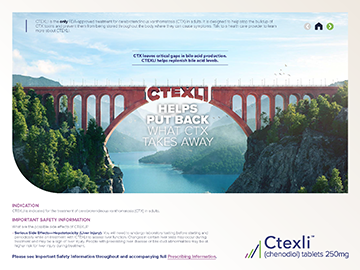
CTEXLI Patient Brochure
Provide this resource to patients who are considering or recently prescribed CTEXLI treatment.
Download Patient Brochure - English Download Patient Brochure - Spanish

Stay in the Know
Fill out this form to receive more information about CTEXLI as it becomes available.
Mirum Access Plus is available to support you, your office, and your patients

To learn more about Mirum Access Plus, contact us at 1-855-MRM-4YOU (1‑855‑676‑4968) Monday through Friday, 8:00 am through 8:00 pm ET.
Visit the MAP website for more information and resources.